 Monitorture
39″ monitor: WQHD (UltraWide) vs 5K2K WUHD
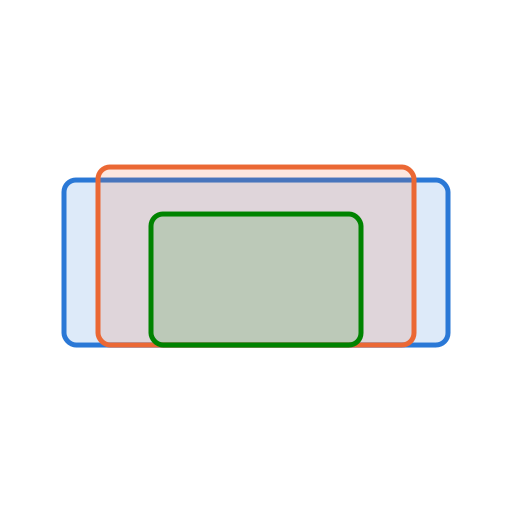
A 39″ monitor is the same physical size — about 35.9″ wide by 15.2″ tall — whatever resolution you pick. What changes is pixel density: more pixels in that fixed area means smaller pixels, sharper text and finer detail. Here's how WQHD (UltraWide) vs 5K2K WUHD compare on a 39″ screen.
| Resolution | Pixels | PPI | Pixel pitch | How it feels |
|---|---|---|---|---|
| WQHD (UltraWide) | 3440 × 1440 | 96 | 0.266 mm | Comfortable — the common desktop sweet spot |
| 5K2K WUHD | 5120 × 2160 | 142 | 0.178 mm | Sharp — you may prefer slight UI scaling |
Which resolution should you get at 39″?
Because the diagonal is fixed, a higher resolution doesn't make the screen bigger — it makes each pixel smaller, so text and edges look crisper. The trade-off is that the interface also shrinks: past roughly ~150 PPI you'll usually want to turn on OS scaling to keep menus and text readable.
For a normal desk viewing distance, about ~95–120 PPI is the comfortable band where the UI reads well at 100% scaling. On a 39″ panel that means WQHD (UltraWide) sits at ~96 PPI (comfortable — the common desktop sweet spot), while 5K2K WUHD reaches ~142 PPI (sharp — you may prefer slight UI scaling) — same screen, noticeably different sharpness.
Viewing distance matters too: the farther you sit, the less a lower PPI shows, so a higher resolution pays off most when the screen is close.